

Winter Baikal: the magic of crystal lake, trekking on transparent ice and where to keep warm after walks
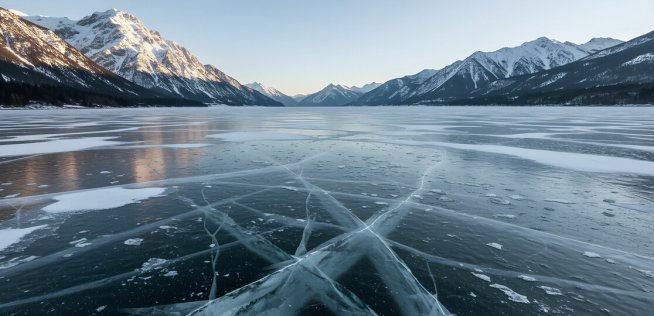
In winter, Lake Baikal turns into the largest skating rink on the planet with an area of more than 30 thousand square kilometers. Transparent ice, hummocks and grottos create landscapes that cannot be found anywhere else. Here you can walk across the frozen surface on foot, see the bubbles frozen in the thickness, hear the "song of ice" and catch the reflection of the stars in the crystal surface.
Baikal in winter is not just beautiful, but fabulous
Winter lake has its own voice. The ice cracks, hums and vibrates, creating a symphony that locals call the "whisper of Lake Baikal." These sounds can be heard from kilometers away and resemble the shots of laser cannons from science fiction films, the rumble of thunder or the low chords of an organ. Most often, "singing" is manifested during temperature fluctuations: at night and at dawn, when the frost is getting stronger, or during the day in sunny weather, when the ice is warming up. At such moments, it seems that the lake is talking to those who have come to its surface.
The transparency of the ice sheet is amazing. In some waters, the bottom can be seen through a meter of ice at a depth of 30-40 meters. The rocks and algae are visible so clearly, as if there is only glass between you. When the sun illuminates the ice at a certain angle, it begins to glow from the inside with turquoise and emerald light. This purity is due to the special structure of Baikal ice — it forms slowly, without impurities and air.
At night, the dome of the starry sky opens over Lake Baikal with a brightness that you will not see in the city. The Milky Way is visible, and sometimes during strong magnetic storms you can catch the northern Lights. The silence here is special: only the cracking of the ice and the sound of the wind. This feeling of cosmic loneliness and unity with nature remains in the memory forever.
Winter trip to Lake Baikal: how to get there
The way to the winter wonderland is most convenient to start from Irkutsk or Ulan-Ude. The flight from Moscow takes about five to six hours. You will have to fly from St. Petersburg to Ulan-Ude with a transfer.
There is another option — Nizhneangarsk airport on the northern coast of Lake Baikal. There are no direct flights from Moscow and St. Petersburg, you can only get there with a transfer through Irkutsk, Ulan-Ude or Krasnoyarsk.
The train is a romantic but long option. The train takes 3.5 days from Moscow to Irkutsk. Many people choose this method for the sake of the views outside the window: the Urals, the taiga, the snow-covered expanses of Siberia.
Irkutsk is most often chosen for the first acquaintance with Lake Baikal. It is only 70 kilometers from here to the village of Listvyanka, the most popular and convenient point on the shore, through which tourists usually get to Lake Baikal for the first time. The journey takes 1-1.5 hours. You can take a taxi, bus or an organized transfer. There is a well-developed infrastructure: hotels, cafes, museums and observation decks, and in winter it is easy to organize ice walks or short excursions.
They get to Olkhon through the village of Sakhyurt, the distance is about 300 kilometers, and the journey takes 5-6 hours. In winter, there is an official ice crossing to the winter island, but it is opened only if the ice is thick enough.
It is convenient to start traveling through the Buryat part of Lake Baikal from Ulan-Ude. Here you can see the datsans, taste the national cuisine and feel the special atmosphere of the east coast. From the capital of Buryatia, the easiest way to get to the village of Turka and to the Chivyrkuysky Bay with its picturesque coves and hot springs.
Nizhneangarsk opens the way to the northern wild routes: hot springs, hiking in the taiga, fishing. This destination requires more time and preparation, so it is usually reserved for the next trip.
Those who plan to rent a car need winter tires and driving experience in the snow. The highway to Listvyanka is usually cleared, but the road to Olkhon can be difficult. Local drivers recommend driving during the day and keeping a shovel, a rope and a supply of frost-free in the trunk. Always check the status of crossings before traveling: movement on the ice is allowed only on official routes.

What is important for a tourist to know about safety on ice
The thickness of the ice on Lake Baikal depends on the month and location. In January, it can reach 50 cm, by February and March — more than a meter. Ice with a thickness of 25 cm or more is considered safe for a group of pedestrians and 30-35 cm for a passenger car.
The most dangerous places are the mouths of rivers, where the current washes away the ice from below. Especially treacherous are the mouth of the Sarma, Cape Kobylya Golova and Ulirba, and the Olkhon Gate Strait. There may be washouts here even in February. Standing cracks — cracks up to 4 meters wide — appear in the same places from year to year. The locals know their location, so it's better to go out on the ice with a guide for the first time.
The safety rules are simple, but mandatory. You can't go out on the ice in a fog or snowstorm — visibility drops to zero in seconds. When driving on ice, keep to the well-trodden trails, they are tested and safe. If you hear a crack, do not panic, the ice is constantly cracking due to temperature fluctuations. But if the crack passes under your feet, step back smoothly, without sudden movements.
For added safety, tourists are advised to take a basic set with them: a rope, a whistle, a flashlight, fire starter tools and a thermos of hot tea. It is better to keep your phone and power bank in a warm pocket — the battery runs out faster in the cold.
Registering a route with the Ministry of Emergency Situations is an important safety measure. This can be done through the official online service or in the nearest departments.

Routes worth taking
Lake Baikal offers many routes in winter, from short walks along the shore to multi-day expeditions. Choose the path you can: there are options for beginners, family tourists and experienced travelers.
Listvyanka — Big Cats
One of the most accessible winter routes for exploring Lake Baikal. It is about 18-20 km from Listvyanka to Bolshye Kotov; in winter, an ice road marked with markers is often laid along the coast, and hiking on the ice takes about 5-6 hours under normal conditions. The M. M. Kozhov Museum of Baikal Studies operates in Bolshye Koty.
Khuzhir — Cape Khoboy
A classic winter walk on the ice of the Small Sea. From the village of Khuzhir to the northern tip of the island is about 40 km in one direction; excursions are usually performed on hivuses, off-road vehicles or snowmobiles, with short walking trips to locations and taking into account the actual ice conditions.
Tankhoy — Listvyanka Crossing
The most famous route stretching 40 km across Lake Baikal in the south of the lake is from coast to coast. Such a transition is performed only in organized groups, with stable ice and clear weather. There are also travel programs with the support of instructors.
The Small Sea and the caves of Sagan-Khushun
Winter routes along the Small Sea allow you to see key ice locations in one day — the caves of Cape Sagan-Khushun, hummocks and transparent areas of ice. Most often they take place on hivuses or snowmobiles, with short stops for walks and photos. The length of such trips ranges from 40-60 km for short programs to about 200 km for circular routes that take the whole day.
"Big Ring"
Multi-day winter programs for 7-10 days connect the western and eastern shores: the routes include Listvyanka, Olkhon, Barguzin Valley, Ust-Barguzin and Chivyrkuy Bay. They travel by cars, hivuses, and snowmobiles.
Natural wonders not to be missed
Unique shapes and ice sculptures are born on Lake Baikal every winter. For example, hummocks are chaotic masses of ice fragments that occur when ice plates contract and collide. In some places, they grow up to several meters. Ice caves form in the rocks and hummocks, in which icicles turn the inner halls into shining galleries.
A rare phenomenon is ice circles with a diameter of kilometers. Scientists associate them with underwater vortices that melt the ice. Most often, circles can be seen from a height or when flying on a drone.
Splashes form on the rocks of Lake Baikal-sokui — when the splashes of waves instantly freeze in layers in the cold and gradually grow into ice cascades. They can reach several meters and resemble frozen waterfalls.
Famous methane bubbles are the hallmark of winter Lake Baikal. Frozen in the ice at different depths, they look like three-dimensional space compositions.

Photo shoots on ice: where to make the most magical shots of winter Lake Baikal
Hummocks are best shot at sunset or dawn, when the side light highlights the texture of the ice. In the Strait of the Small Sea between Olkhon and the mainland, particularly interesting ice ridges are noted. Transparent boulders glow blue and turquoise in the sun. For scale, it's good to include a person in the frame — this will emphasize the grandeur of the ice formations.
The best places to shoot ice bubbles are Cape Kobylya Golova near Bolshoy Goloustnoye and the vicinity of Buguldeika village. Professional photographers recommend choosing a time when the sun is not too low and using polarizing filters to reduce glare.
Night shooting requires preparation, but the result is worth it. The best locations are Cape Khoboy and Ogoy Island, where there is minimal illumination from populated areas. On a clear night, you can see the Milky Way, and if you're lucky, the northern Lights. You will need a tripod for shooting, a shutter speed of 15-30 seconds (depending on the aperture and focal length of the lens), high ISO values — about 1600-3200. Keep the batteries warm and take spare ones — they run out three times faster in the cold.
Ice caves and caves look most spectacular from the inside. The light penetrating through the icy walls colors the space in blue and green tones. Use a wide-angle lens for shooting and shoot in RAW for post-processing. It is better not to use a flash — it kills the natural play of light.

Where to keep warm after ice: cozy hotels and baths on Lake Baikal
After long hours in the cold, returning to the warmth is especially appreciated. On Lake Baikal, it is easy to find guest houses and complexes with baths, saunas and fireplaces, and even a Japanese font in the open air. And in Bolshoy Goloustnoye, you can stay in heated yurts — an unusual but very cozy format for winter holidays and a real reward for a day on the ice.
For those who plan trips to Lake Baikal from the city, the ibis Irkutsk Center will be a convenient option. The hotel is located in the very center of Irkutsk, 20 minutes by taxi from the airport and 72 km from Listvyanka. The hotel has an Alista SPA Center with a hammam and a relaxation pool. Guests staying at the hotel can spend 1 hour in the aquazone of the center for free.


What to take to Lake Baikal
It is important to choose the right clothes so as not to spoil the trip. A well-designed kit is a guarantee of warmth, comfort and freedom on the ice.
So, the layer system in clothes works better than one warm jacket:
- the first layer is thermal underwear made of merino wool or high-quality synthetics;
- the second one is a fleece or sweater;
- The third is a warm membrane jacket that protects from the wind.
When moving actively, you can remove the middle layer, and when stopping, put it back on.
Choose shoes a size larger than usual — there should be room for a warm sock and insole. The sole must necessarily have a tread, preferably with spikes or the ability to put on ice shoes.
We protect our heads and hands especially carefully. The hat should cover the ears, ideally with a windproof membrane. A balaclava or buff will protect your face from weathering. Take two pairs of gloves: thin fleece gloves for taking photos and thick mittens for long walks. Sunglasses are also required — ice and snow strongly reflect light.
Appliances also need to be protected from the cold. Wear the camera under your jacket, take it out only for shooting. Keep the spare batteries in your inner pockets. Choose a powerbank starting from 20,000 mAh — the capacity drops by half in the cold. We recommend putting a hermetic bag for documents, anti-chapping cream and hygienic lipstick in the backpack. Thermal warming packs and a rescue insulated blanket will be useful in an emergency situation. Don't forget your personal medicines and cold remedies — there won't be pharmacies everywhere along the route.

When is the best time to go to Lake Baikal in winter
The time of the trip depends on the goals. January is the time of pioneers. The ice has just risen, there are few tourists, the nature is wild and untouched. The temperature drops to -25...-30 °C, but you can see the hummocks forming and hear the young ice singing. This is a month for experienced travelers and lovers of extreme sports.
February is the golden mean of the season. The ice has reached its maximum transparency and thickness, and it is safe to walk on it. Daylight hours are already noticeably longer, and daytime temperatures range from -10 to -20 °C. Most winter tours and excursions operate in February. This is the perfect time to explore winter Lake Baikal for the first time.
March brings more light and warmth. During the day, temperatures can rise closer to -5 °C on warm days, but the ice remains firm.
Everyone who has seen Lake Baikal in winter returns a different person. This place teaches you to appreciate simple things, shows how beautiful and powerful nature is. It gives you memories that warm your soul on long winter evenings. Baikal in winter is more than a trip. It's a meeting with the real me on the edge of the frozen sea under the endless Siberian sky.

