

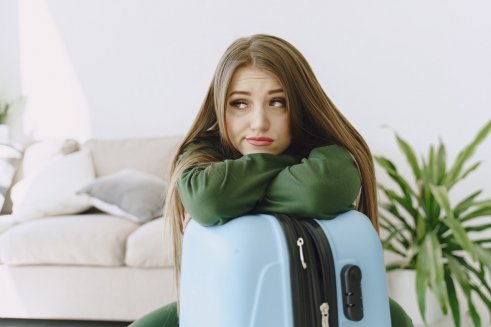
Open up to a new one: how to deal with stress and anxiety while traveling
Travel is usually portrayed as a continuous stream of delight. But often a trip is an exit from the comfort zone, which can be accompanied by excitement. Stress during packing, on the road, and at the point of arrival is a normal mental reaction to a change in the familiar environment. You can learn to control this state so that it doesn't interfere with discovering the world. We have put together a practical guide that will help you understand the nature of travel anxiety and find support for peace of mind.
Why Travel causes Stress and Anxiety
There are specific psychological mechanisms behind the feeling of anxiety before or in the midst of a trip. This is a protection system that is activated in unusual conditions. Main triggers:
- Fear of uncertainty. The brain, deprived of familiar landmarks, goes into high alert mode, trying to predict potential threats. This feels like anxiety.
- Loss of control. At home, you manage your daily routine and daily routine — a lot depends on other people on the way. Reducing one's own influence on the situation can be uncomfortable.
- New people, rules, language. Every little thing, from finding an exit at the train station to unfamiliar norms of behavior, requires additional mental resources. This leads to tension and fatigue.
- Past negative experiences. A fright experienced during turbulence, loss of luggage, or illness away from home leave vivid and unpleasant marks in the memory. Before a new journey, the brain sends signals about possible danger.
It is important to understand that this internal "alarm system" is well-intentioned. The first step to not worrying on vacation is not to deal with anxiety, but to accept it. When you realize that this is how the psyche reacts to novelty and possible risks, the emotion becomes more understandable, and therefore manageable.

How anxiety increases: from agitation to panic states
It is important to distinguish the degree of discomfort in order to choose the right self-help strategy. In most cases, we are dealing with natural reactions that can be quickly regulated.
The usual excitement before a trip is familiar to almost everyone. This is a slight anxiety, "butterflies in the stomach", thoughts like "did I take everything?". This condition is short-lived and does not interfere with planning. It can even mobilize forces, help you not to lose sight of anything.
An anxiety attack is a more intense and prolonged condition. Anxiety becomes a background that is difficult to ignore. It can be accompanied by a feeling of tension in the body, difficulty concentrating, and obsessive scrolling through the same negative scenario. It becomes extremely difficult to relax, enjoy the fees and travel.
The most acute form is a panic attack. This is a sudden, often unexplained episode of extreme fear, which is accompanied by vivid physical symptoms: palpitations, a feeling of lack of air, dizziness, trembling. At this point, it may seem that something life-threatening is happening. It is important that the difference between a panic attack and ordinary anxiety is in the intensity and suddenness, and not in the presence of the symptoms themselves. A slightly rapid pulse and other uncomfortable sensations in moments of excitement are the norm.
The effects of most reactions can be mitigated with simple techniques. But if panic episodes repeat, the fear of them begins to affect your plans, anxiety prevents you from living, it is better to consult a psychologist.
Preparation is the foundation of peace of mind
The principle of dealing with anxiety is simple: the higher the level of predictability, the lower the anxiety. Your task is to create a framework for the trip that gives you a sense of control. Start with the foundation:
- Detailed route planning. Plot your way from the airport to the hotel, mark the key points on the map. Knowing what's coming after what reduces the field for disturbing fantasies.
- Working with documents and insurance. Check the validity period of your passports in advance, and make electronic copies of tickets, visas, and insurance policies. Travel insurance is not just a formality: This is the basis of your peace of mind in case of illness or unforeseen events.
- Planning a budget. Calculate approximate expenses for transportation, housing, food and entertainment, setting up a reserve for unforeseen expenses. Financial clarity removes one of the strongest sources of stress.
- Making a plan in case something goes wrong. Mentally think over simple algorithms: "if I lose my card, I have cash and a digital copy," "if I miss my flight, I know how to contact the airline and the hotel." This will give you confidence in your ability to handle unpleasant surprises.

Packing a suitcase without panic
The chaos in a suitcase often reflects the chaos in your thoughts. Put things in order in the bag, and the alarm will have fewer supports.
We recommend following the proven recommendations:
- Use checklists. The list of things saves you from agonizing thoughts about what to take, what is already packed, what is forgotten.
- Rank things by importance. First, put down the documents, medicines, chargers — something without which the trip is impossible. Then everything else.
- Make your carry-on luggage a "lifeline." Put in there the most necessary things for the first day (linen, basic hygiene products), documents, money.
- Discard things "just in case." Leave in your suitcase only what you will not be able to get out of hypothetical critical situations without.
Order from the outside really helps to reduce strife from the inside. When the main risks are calculated and things are packed systematically, there is nothing to get excited about — you start to relax.
How to deal with anxiety on the road
Even the most careful preparation still does not guarantee complete peace of mind on the way. On an airplane, train, or bus, sudden waves of anxiety can cover you. Your task at such a moment is not to remove the anxiety completely, but to reduce its intensity to an acceptable level. There are proven methods for this:
- Breathing exercises. Focus on exhaling — it calms the nervous system. Try the 4-7-8 technique: inhale slowly through your nose for 4 counts, hold your breath for 7, then exhale gently through your mouth for 8. Repeat 3-4 times.
- Grounding technique "5-4-3-2-1". If you feel that you are losing your footing, return to reality and the current moment through your senses. Look around and find: 5 objects that you see, 4 tactile sensations, 3 sounds, 2 smells, 1 taste in your mouth.
- Targeted distraction. Prepare a book, a TV series, a movie, or a complex puzzle in the app in advance. Fully immersed in a story or task creates the necessary cognitive load, displacing the disturbing stream of thoughts.
- Simple physical activities, physical practices. Squeeze and relax your fists a few times, stretch, slowly turn your head, massage the points on your temples. Cold water contact also helps: apply a bottle of water or a cold metal spoon to your forehead or wrists.
The effectiveness of these ways of dealing with anxiety increases with practice. Experiment in advance in a calm environment, so that in a moment of great excitement when traveling, you can use the already proven method.

What to do to reduce the excitement in a new place
Coming to an unfamiliar city, despite all the joy, is a new dose of uncertainty. Effectively dealing with stress while travelingat this stage means consciously helping yourself to adapt. Instead of rushing to see the sights right away, take the time to adapt. Some practical tips:
- Don't overload the first few days. Give up a busy schedule. It's better to look at one or two places slowly than to run through five, getting only tired and not getting rid of the excitement.
- Recreate household rituals. It can be a morning cup of coffee by the window, evening diary entries or a walk in the nearest park. Simple repetitive actions give the brain a signal of stability.
- Keep a regular routine. Try to follow your sleep schedule, meal schedule, and physical activity. A body that lives according to an understandable rhythm sends fewer alarm signals to the brain.
- Allow yourself a break. If you feel overwhelmed, return to the hotel and just relax. Adaptation requires energy, and giving yourself time to recover is not a weakness, but a smart move.
To adapt to a new place and get rid of unnecessary anxiety, it is useful to choose a comfortable and cozy hotel. This is your zone of peace and security. The opportunity to return to a pleasant environment, sleep in a good bed, be alone in silence — all this provides resources to deal with stress during a trip. You can book a trusted hotel that will become a safe haven on your trip on our website.
To summarize
Traveling is not about the absence of fear or excitement, but the ability to move forward with them. Don't try to get rid of anxiety completely. She is a natural companion on the way to new horizons. Identify your own set of reliable tools that will help reduce stress to a normal level.
The ability to cope with excitement makes trips more enjoyable, expands your boundaries, and turns every trip into a story full of vivid and enjoyable experiences. To avoid unnecessary stress, choose a reliable hotel where comfort, tranquility and high-quality service await you. Book a room at accor.ru and confidently embark on new adventures.

